
Does a Will Cover CPF Savings in Singapore?
No. Your CPF savings do not form part of your estate, so your Will cannot distribute them.
Even if your Will leaves “all your assets” to one person, that instruction does not apply to CPF savings covered by the CPF nomination scheme.
Even if your Will leaves all your assets to one person, that instruction does not decide who receives your CPF savings.
CPF savings are handled separately from the rest of your estate.
If you have made a valid CPF nomination, CPF Board distributes the covered CPF monies to your nominees according to the proportions stated in your nomination.
What Does a CPF Nomination Cover?
A CPF nomination generally covers the following:
- savings in your Ordinary Account;
- savings in your Special Account;
- savings in your MediSave Account;
- savings in your Retirement Account;
- your remaining CPF LIFE premium balance, where applicable; and
- discounted Singtel shares. (Central Provident Fund Board)
Your nomination states who should receive your CPF savings and the percentage for each nominee. You can name up to 15 nominees online. To name more than 15, visit a CPF Service Centre.
You may nominate anyone, including someone who does not have a CPF account.
What Happens if You Pass Away Without a CPF Nomination?
If you pass away without a valid CPF nomination, your CPF savings are not distributed according to your Will.
Instead, CPF Board transfers them to the Public Trustee’s Office for distribution:
- under the Intestate Succession Act for a non-Muslim; or
- under the Administration of Muslim Law Act for a Muslim.
The result may be very different from what you set out in your Will.
Without a nomination, the Public Trustee’s Office may take up to six months to identify eligible family members and will deduct an administrative fee before distribution.
This is an important reason to consider your Will and CPF nomination together as part of your estate plan.
Does a Will Cover Property Bought Using CPF?
Property is treated differently from the CPF savings used to buy it.
Property purchased using CPF savings is not covered by a CPF nomination. What happens to it depends on how the property is owned.
What happens to your share of the property depends partly on how you own it.
Joint Tenancy
If the property is held under a joint tenancy, the late owner’s interest passes automatically to the surviving joint owner or owners, regardless of what the Will says.
Tenancy-in-Common
If a property is held as a tenancy-in-common, each owner has a distinct share.
That share forms part of the estate and may pass under the Will. If there is no valid Will, it is distributed under the applicable intestacy rules.
This distinction is especially important for HDB flats and jointly owned private property.
What Happens to Investments Bought With CPF?
Investments under the CPF Investment Scheme (CPFIS) are not covered by a CPF nomination.
When a CPF member passes away, CPFIS investments and any cash balance in the Investment Account form part of the estate.
The executor or administrator should contact the relevant product provider or agent bank to claim these assets.
An exception applies to insurance policies bought under CPFIS where a valid insurance nomination has been made with the insurer. In that case, the nominated beneficiaries may claim the policy benefits directly from the insurer.
Does Marriage Affect Your CPF Nomination?
Yes. Marriage revokes an existing CPF nomination.
CPF Board recommends making a new nomination after marriage so that your CPF savings continue to be distributed according to your wishes.
People sometimes update their Will after marriage but forget to make a new CPF nomination.
Does Divorce Revoke a CPF Nomination?
No.
Unlike marriage, divorce does not automatically revoke your CPF nomination.
If your former spouse is a nominee, review the nomination after divorce to ensure it still reflects your wishes.
The same principle applies following other significant life changes, including the birth of a child or the death of a nominee.
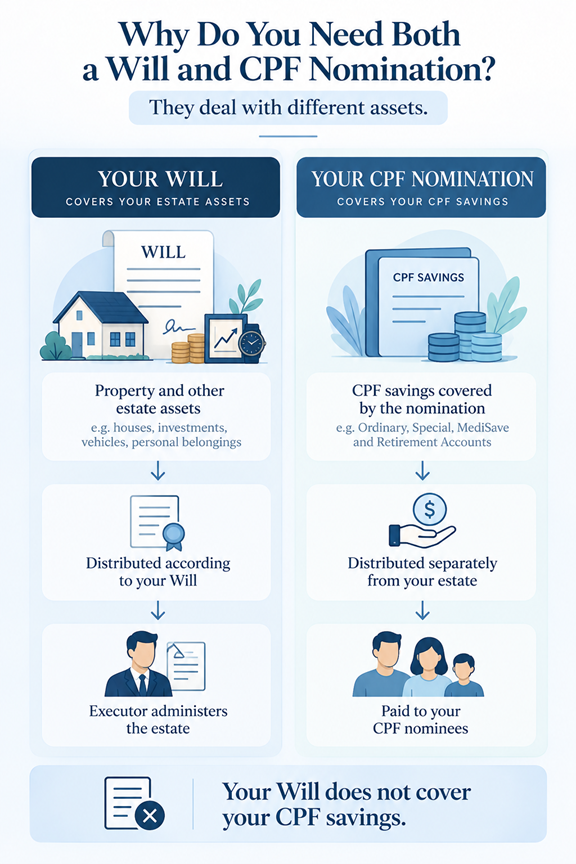
The CPF Board confirms that CPF savings do not form part of your estate and cannot be controlled by your Will. A valid CPF nomination determines how those savings are distributed.
Estate planning should therefore consider both documents, rather than treating a Will as covering everything.
When Should You Review Your Will and CPF Nomination?
Review your estate plan whenever your personal or financial circumstances change.
This may include:
- getting married;
- getting divorced;
- having children;
- the death of a beneficiary or CPF nominee;
- purchasing or selling property;
- significant changes to your assets; or
- changes in who you wish to benefit from your estate.
CPF Board specifically recommends reviewing nominations following significant milestones such as marriage, childbirth, divorce and the death of a nominee.
Your Will should similarly be reviewed periodically to ensure that it continues to reflect your circumstances and intentions.
How GJC Law Can Help
Estate planning is not only about deciding who receives your assets. It also means understanding which assets your Will controls and which require separate arrangements.
GJC Law’s estate lawyers can advise on Wills and estate planning, including how your Will works alongside CPF nominations, property ownership, insurance nominations and other arrangements.
Speak with GJC Law to review your Will or put suitable estate-planning arrangements in place.
Frequently Asked Questions
Can I leave my CPF savings to someone in my Will?
No. CPF savings covered by the CPF nomination scheme do not form part of your estate and cannot be distributed through your Will. You should make a CPF nomination if you want to specify who receives those savings.
What happens to my CPF savings if I have a Will but no CPF nomination?
Your Will does not control your CPF savings. If you pass away without a valid nomination, CPF Board transfers the savings to the Public Trustee’s Office for distribution under the applicable intestacy laws or Muslim inheritance rules.
Can I nominate someone who is not a family member?
Yes. You may nominate anyone, including someone who is not a family member or does not have a CPF account.
Do I need someone to witness my nomination?
Yes. An online nomination requires two witnesses. They must be at least 21 years old, have mental capacity and hold a Singpass. Neither you nor your CPF nominees may act as witnesses.
Does my CPF nominee need a CPF account?
No. A nominee does not need a CPF account. CPF savings are generally paid to nominees in cash.
Does marriage cancel my CPF nomination?
Yes. Marriage revokes an existing CPF nomination. Make a new nomination after marriage if you want your CPF savings distributed according to your wishes.
Does divorce cancel my CPF nomination?
No. Divorce does not automatically revoke a CPF nomination. Review it after divorce and update it if it no longer reflects your wishes.
Are properties purchased with CPF covered by my CPF nomination?
No. Property purchased using CPF savings is not covered by a CPF nomination. The outcome depends on whether it is held in sole ownership, joint tenancy or tenancy-in-common.
Are CPFIS investments covered by my CPF nomination?
No. CPFIS investments and any cash balance in the Investment Account generally form part of the estate. An exception applies to insurance policies with a valid nomination made with the insurer.