
How Long Does a Grant of Probate Take?
The Singapore Courts estimate that a straightforward Grant of Probate application takes approximately 2 to 3 months, depending on the complexity of the case.
That estimate is more likely to apply when:
- there is a valid Will;
- the executor is clearly identified;
- the necessary documents are available;
- the deceased’s assets can be identified;
- the documents are properly prepared and filed; and
- there are no disputes, caveats or competing applications.
If the deceased did not leave a valid Will, the appropriate application may instead be for Letters of Administration. The Singapore Courts also estimate about 2 to 3 months for a straightforward application, depending on complexity.
Read more: A Comprehensive Guide to the Probate Process in Singapore
What happens during the application?
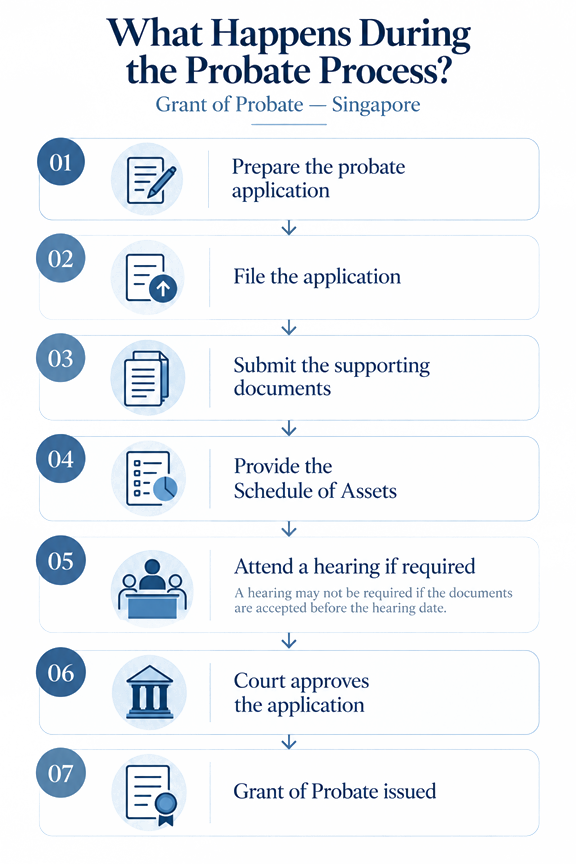
The executor must identify the deceased’s assets and list them accurately in the Schedule of Assets. This schedule may be filed with the initial application or later.
After the application is filed, the Supporting Affidavit and Administration Oath generally must be submitted within 14 days. If more time is needed, an extension must be requested. If the documents are in order, the Court may grant the application without a hearing.
The Grant is issued only after the Court has approved the application and all relevant supporting documents, including the Schedule of Assets. If the Schedule is filed later, a Supplementary Affidavit confirming its accuracy is also required.
What Can Delay Probate?
A probate application may take longer when the Court needs further information, corrected documents or additional steps.
Incomplete or Incorrect Documents
Missing information, inconsistent details or incorrectly prepared documents may have to be corrected before the application can proceed.
The Singapore Courts publish guidance on common errors in non-contentious probate applications, which shows why careful preparation matters.
Difficulty Identifying the Assets
The executor may need information from financial institutions and other asset-holding entities to find out what the deceased owned and owed.
Delays in obtaining this information can hold up the Schedule of Assets.
The Schedule of Assets Is Not Ready
The Court cannot issue the Grant until it has approved the relevant supporting documents, including the Schedule of Assets.
If the Schedule is filed after the Supporting Affidavit, the executor must also file a Supplementary Affidavit confirming that the Schedule is true and accurate.
Questions About the Will
Questions may arise about the original Will, its validity, any amendments or codicils, or who is entitled to act as executor.
These issues can turn a straightforward application into a more complex one.
A Caveat Has Been Filed
A caveat is a formal step taken by someone who claims an interest in the estate and wants to be heard before a Grant is issued.
While a caveat is in force, the application may not proceed in the usual way until the issue has been addressed.
There Is a Competing Application
A competing application may arise when more than one person seeks authority to deal with the same estate.
The Court may need the competing claims to be resolved before issuing a Grant.
What Happens After Probate Is Granted?
Receiving the Grant is an important milestone, but it is usually not the end of the estate administration.
The Grant legally recognises the executor’s authority to manage the deceased’s estate.
The executor may then need to:
- contact financial institutions;
- collect or transfer money and investments;
- deal with property;
- sell assets where necessary;
- pay debts and estate expenses;
- address tax or other liabilities, where applicable; and
- distribute the remaining estate to the beneficiaries.
Some financial institutions may ask for a certified true copy of the Grant, Schedule of Assets or Will before releasing assets.
How Long Does Estate Administration Take?
There is no single timeframe that applies to every estate.
A simple estate with easily identified assets and beneficiaries may be completed relatively quickly. An estate involving a property sale, overseas assets, business interests, debts or disagreements may take much longer.
The Court’s 2-to-3-month estimate refers to obtaining the Grant in a straightforward case. It is not a promise that the entire estate will be distributed within that period.
Can the Process Be Made Faster?
There is no guaranteed way to speed up a probate application. However, good preparation can help avoid unnecessary delays.
Helpful steps include locating the original Will, obtaining the death certificate, identifying assets and liabilities, gathering financial records, and checking that the application and supporting documents are complete and consistent.
Eligible applicants may use the Singapore Judiciary’s Probate eService. It is available only for certain cases, including applications by a named sole executor where the estimated estate value does not exceed S$2 million and the other eligibility requirements are met.
When Should You Speak to a Probate Lawyer?
You do not need a lawyer to file a Grant of Probate application. However, legal advice may be helpful where the estate or application is not straightforward, for example where:
- the Will cannot be located;
- there are concerns about the validity of the Will;
- an executor cannot or does not wish to act;
- there is a caveat;
- another probate application has been filed;
- beneficiaries disagree;
- assets are difficult to identify;
- the estate includes overseas assets; or
- there is uncertainty about how the estate should be administered.
Legal advice can be particularly useful where there are caveats, competing applications or disputes, as these matters may require additional court procedures.
How GJC Law Can Help
GJC Law’s estate lawyers assist executors and families with Grant of Probate applications and estate administration in Singapore. This may include preparing court documents, advising on procedural requirements and addressing issues that arise before the Grant is issued.
For more complex estates, we can also advise on issues involving executors, beneficiaries, estate assets, caveats, and the administration and distribution of the estate.
Speak with GJC Law if you need advice or assistance with a Grant of Probate or estate administration in Singapore.
Frequently Asked Questions
How long does a straightforward Grant of Probate take in Singapore?
The Singapore Courts estimate approximately 2 to 3 months, depending on the complexity of the case.
Is the 2-to-3-month period calculated from the date of death?
No. The estimate relates to the time needed to process a straightforward application. It should not be read as running automatically from the date of death, and actual timing depends on when the application and required documents are filed and accepted.
How soon after death can probate be applied for?
The executor can begin preparing the application once the necessary information and documents are available. The application should generally be filed within 6 months of death. If it is filed later, the applicant must explain the delay.
What happens if there is no Will?
If there is no valid Will, the appropriate process may be an application for a Grant of Letters of Administration. For a straightforward application, the Singapore Courts also estimate about 2 to 3 months, depending on complexity.
Does receiving the Grant mean beneficiaries are paid immediately?
No. The executor may still need to collect assets, deal with property, pay debts and expenses, address any tax or other liabilities, and complete the administration before distributing the remaining estate.
Can a probate application take longer than 3 months?
Yes. The 2-to-3-month period is only an estimate for a straightforward case. Missing documents, difficulty identifying assets, caveats, competing applications or other complications may extend the process.
Do I need a lawyer to apply for probate?
No. A lawyer is not required to file a Grant of Probate application. However, you may wish to obtain independent legal advice if the estate or application is complex.